Psychological Safety
On October 11, 2018 in notes • 2 minutes readTags: peopleware • team-dynamics • culture
Table of Contents
People are not afraid of failure, they're afraid of blame - Seth Godin
Introduction
Coined by Harvard Professor Amy Edmondson, Psychological Safety has been found to be at the heart of great teams. She defines psychological safety as “a shared belief that the team is safe for interpersonal risk taking” and explains that psychologically safe environments exude “a sense of confidence that the team will not embarrass, reject, or punish someone for speaking up.”
Importance of Psychological Safety
Google’s Project Aristotle is a landmark study of teamwork and team performance. Project Aristotle started in 2012 and published its findings in 2015, identifying five critical factors for a team’s success:
- Psychological safety: How comfortable do you feel taking risks on the team without feeling insecure or embarrassed?
- Dependability: Can you depend on your teammates and hold them accountable? Can you expect team members to consistently achieve excellence?
- Structure and clarity: Are goals and roles clearly defined?
- Meaning of work: Is everyone on the team working on something that is personally important to them?
- Impact of work: Do you believe that the work you are doing matters?
The project identified that psychological safety was the most important.
Learning Zone
Organizations have to focus on performance. The challenge is to keep learning even while performing at peak levels. A useful model to understand what really happens in organizations is a 2 x 2 matrix. On one axis, we have performance pressure (accountability for results). On the other axis, we have psychological safety.
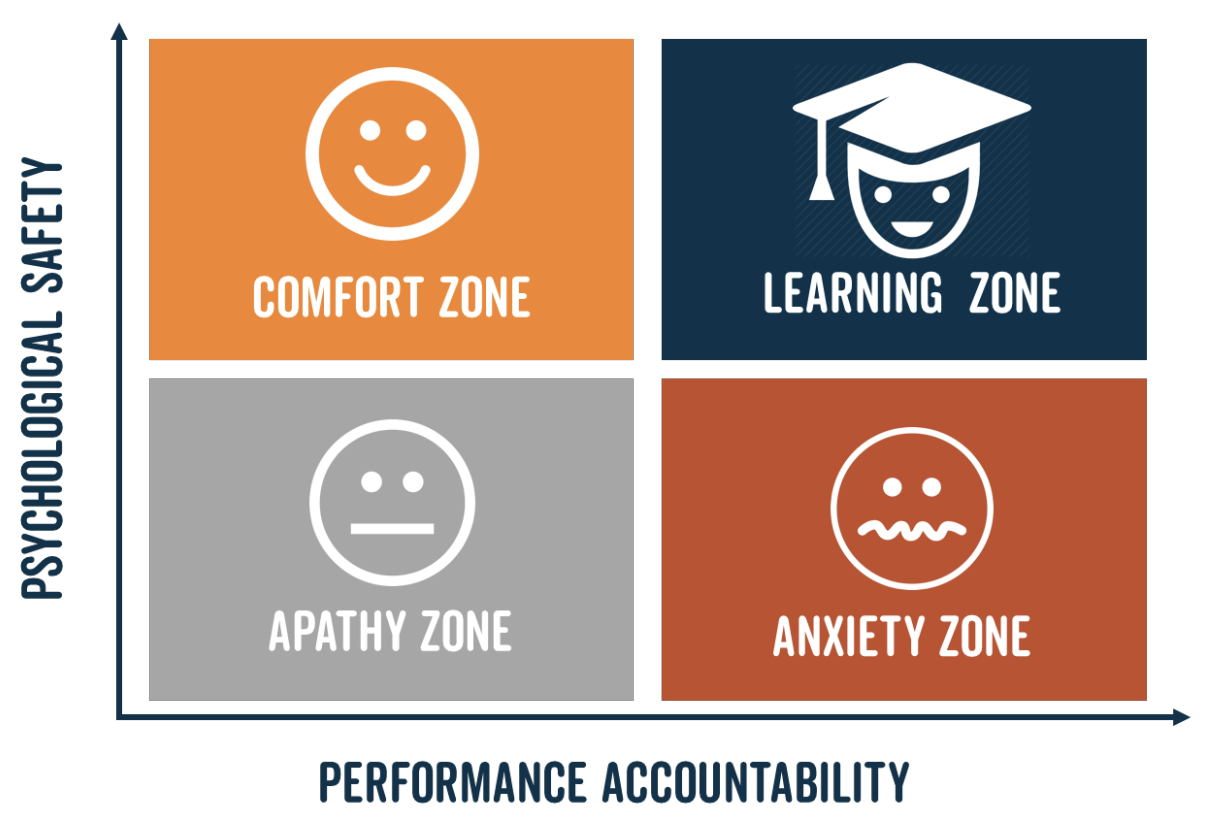
- When psychological safety as well as accountability levels are low (apathy zone), employees are apathetic and constantly jockey for positions.
- Bureaucratic organizations where currying favor rather than sharing ideas is the norm typify this zone. When accountability is high but the necessary psychological safety is absent (anxiety zone), employees are stressed and anxious. They are wary to experiment, to offer new ideas, or to seek help. Burnout is a frequent outcome. Banks and consulting are typical examples.
- Environments in which psychological safety is high but without performance pressures (comfort zone) are breeding grounds for complacency. There is hardly any sense of urgency and doing the minimum is the norm. Family businesses and small firms can be found in this quadrant.
- Teams that operate in the learning zone often frame their work as a learning challenge: one that entails experimentation, trial and error and has room for failure. This zone is also known as the Performance zone.
In practice
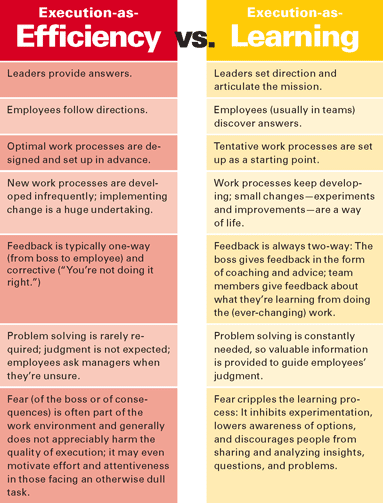
Three building blocks are suggested for the learning organization:
- A supportive learning environment: Appreciates opposing viewpoints and new ideas
- Concrete learning processes and practices: Tools for collaboration and process guidelines that not so much produce efficiency, but facilitate learning by gathering data and fostering reflection
- A leadership that reinforces learning: Makes work about learning and not executing, embraces its own fallibility, is a model for curiosity
Related
Most related
- September 14, 2018: On Estimating
- April 22, 2021: Manual
- August 24, 2018: London
- September 03, 2018: CAP
- June 22, 2019: Object Oriented Programming
- September 03, 2018: System Design
- June 22, 2019: Load Balancing
- October 10, 2018: Radical Candor
- July 04, 2019: 99 Bottles of OOP
- October 10, 2018: Objectives and Key Results