Mindmapping STAR
On September 11, 2018 in notes • 3 minutes readTags: interviewing • preparation
Table of Contents
This is how I prepare for interviews.
Background
Over the years, I have accumulated a lot of experiences. Unfortunately, whenever I am asked a “Tell Me About a Time…” question I tend to draw a blank and forget all of them. In addition, over the years, due to the way memory works, my experiences tend to merge and mix. I completely forget relevant things I’ve done and could talk about.
Nothing worse than leaving an interview and getting that feeling of “Why didn’t I tell them about THAT”?
In addition to that, trying to come up with a good answer on an experience in your past requires some level of preparation; trying to get it all together while you are there with your interview can be risky, and the answer can come out jumbled.
To fix this, I’ve come up with a system for preparing for soft-skills interviews. Let me explain it.
Step 1: Visual Recalling
Once you’ve got your “Tell Me About a Time…” question it’s time to reach into your memory and pick the right one. The easiest place to start from would be your resume. Yet, your resume has two problems:
- Not all your experiences will fit on a resume
- Your resume is not a great tool for visual memory
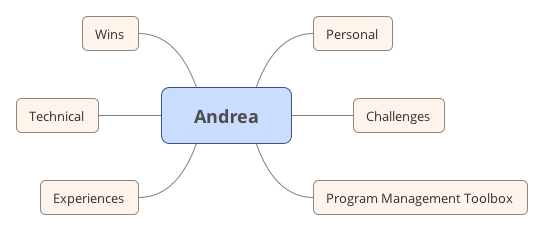
My solution to this problem is a mind-map (I recommend XMind to create it) of my experiences, technical and non-technical competencies, personal strengths and weaknesses; I also create a section for role-specific knowledge I posses and for challenges that don’t quite fit in any other category.
The “spine” of the mindmap looks a bit like this one:
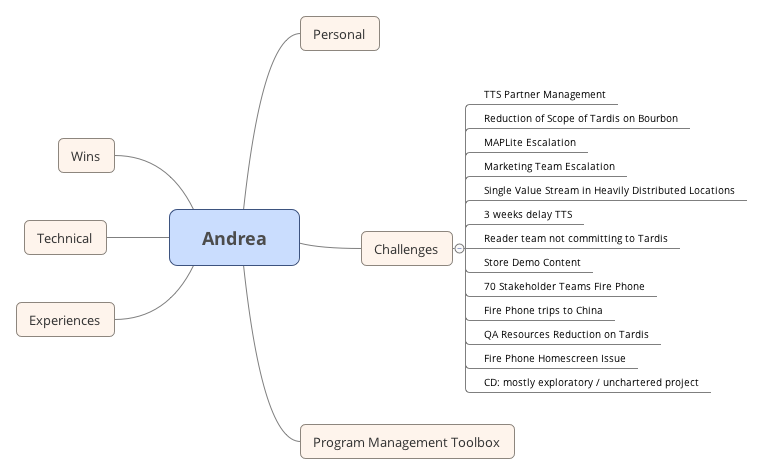
Once I have this, I start going through my resume and past notes and populate the mind-map until it has the level of detail I want. For example, for challenges, I have something like this:
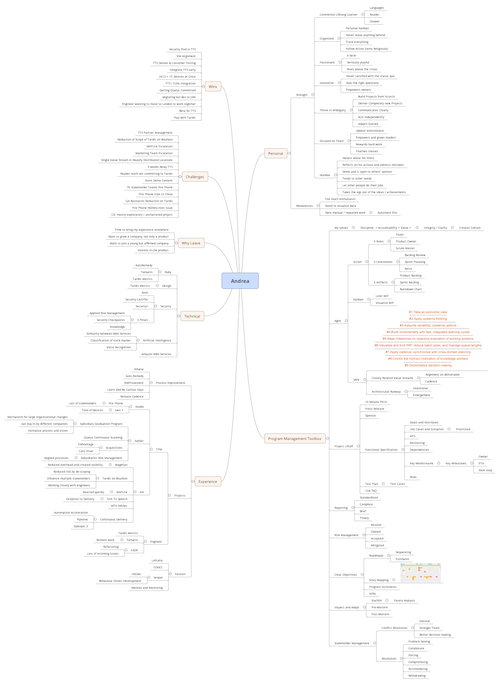
Mine looks something like this:
Step 2: Answering
Armed with your mind-map, it should be easier now to find the experience that fits the best the question you’ve been asked. The next step is to practise answering using the Situation-Task-Action-Result (STAR) method.
For example, let’s say the question is “Tell me about a time when you had to solve a large cross-functional issue with no clear cause”, I will practice my answer (in front of a mirror!) as follows:
- Situation: When I worked at Amazon.co.uk, I was part of the Prime Video Living Room team. In this team, releasing new versions of our software to our customers was always a highly ceremonious endeavour, which we could only complete once every 2 months. In addition, even with a QA team of 20 people, we were still not able to catch all issues before they reached customers.
- Task: I was tasked by the Director of Prime Video Living Room to solve this problem and shorten our release cycle, while reducing the resources utilised by the process.
- Action: I defined a vision for the improvements we wanted; it went something like “By J date we will release X time every Y, with less than Z issues and by reducing waste (# of QA hours spent testing without finding issues?) by T%”. Working with the engineering teams, we found the main blockers to implementing this vision, and I empowered different engineering managers to solve different parts of the problem.
- Result: In the end, we were able to move to a bi-weekly release cadence within two months; this was a bold move as there were some open risks, which we had evaluated. We had some issues, learned from them, and improved our practices.
The answer above is reasonably detailed, not too long, and has provided the interviewer with a very basic understanding of my experience; there is now plenty of space for them to continue to dive deeper on the parts that they find more relevant.
Step 3: Iterate
As you keep answering your questions with the STAR method you’ll remember more things! At this point go back to Step 1 and improve your mind-map :)
Related
Most related
- September 14, 2018: On Estimating
- October 10, 2018: Objectives and Key Results
- October 10, 2018: Radical Candor
- April 22, 2021: Barrels and Ammunitions
- September 14, 2018: Coaching
- September 04, 2019: High Standards
- June 10, 2019: Organisational Design
- October 11, 2018: Psychological Safety
- July 04, 2019: 99 Bottles of OOP
- June 22, 2019: Load Balancing